Waste transfer notes, consignment notes and your duty of care
When waste moves from one business to another, responsibility for it moves too. The transfer note records the handover. From 1 October 2026, receiving sites in England and Wales add a digital receipt record; existing notes and returns continue until further notice.
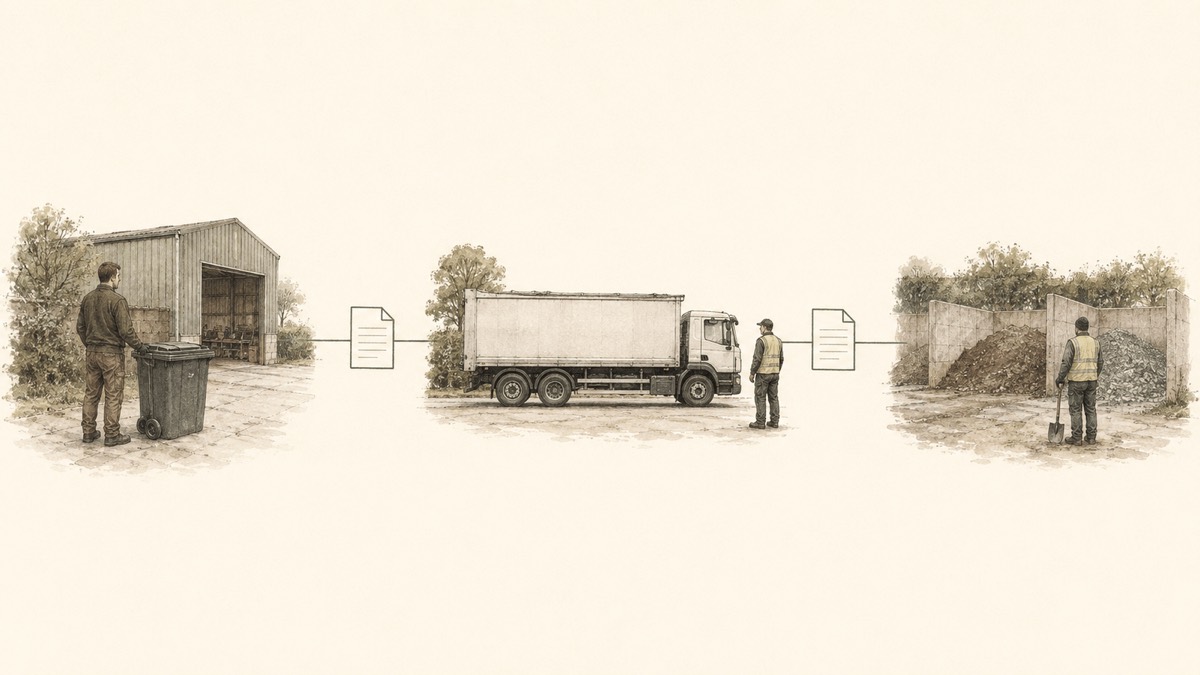
Everyone in the chain carries it
In 1990 the duty of care replaced the handshake with a paper trail. From October 2026, a digital receipt record is added alongside that existing record-keeping under powers in section 58 of the Environment Act 2021.
The duty itself sits in section 34 of the Environmental Protection Act 1990 and applies to anyone who produces, carries, keeps, treats or disposes of controlled waste. In plain terms: store it safely, describe it accurately, hand it only to someone authorised to take it, and keep a record of every transfer.
Each handover, from the business that created the waste to the carrier who moves it and the site that receives it, has to be recorded so the whole journey can be followed back. If a load ends up somewhere it shouldn't, that record is what shows who did their job and who didn't.
Two documents, two kinds of waste
Waste transfer note (WTN), for non-hazardous waste. Its official title is "Duty of Care: Waste Transfer Note". Keep it for at least two years.
Hazardous waste consignment note (HWCN), for anything classed as hazardous: oils, solvents, batteries, asbestos, contaminated soils and so on. It is needed whenever hazardous waste moves, including between your own premises. Retention depends on your role: producers and holders generally keep their copy for three years; permitted receiving sites may need to keep records for five years, and permit conditions can require longer.
Both need the six-digit waste code from the List of Waste (often still called the EWC code) and an accurate description. The digital receipt record also asks for hazardous components and concentration values, or a reason if a value is unavailable.
What a compliant transfer note contains
Every field earns its place. Leave one out and the note may not stand up when the regulator asks for it, or the load may be paused at the gate.
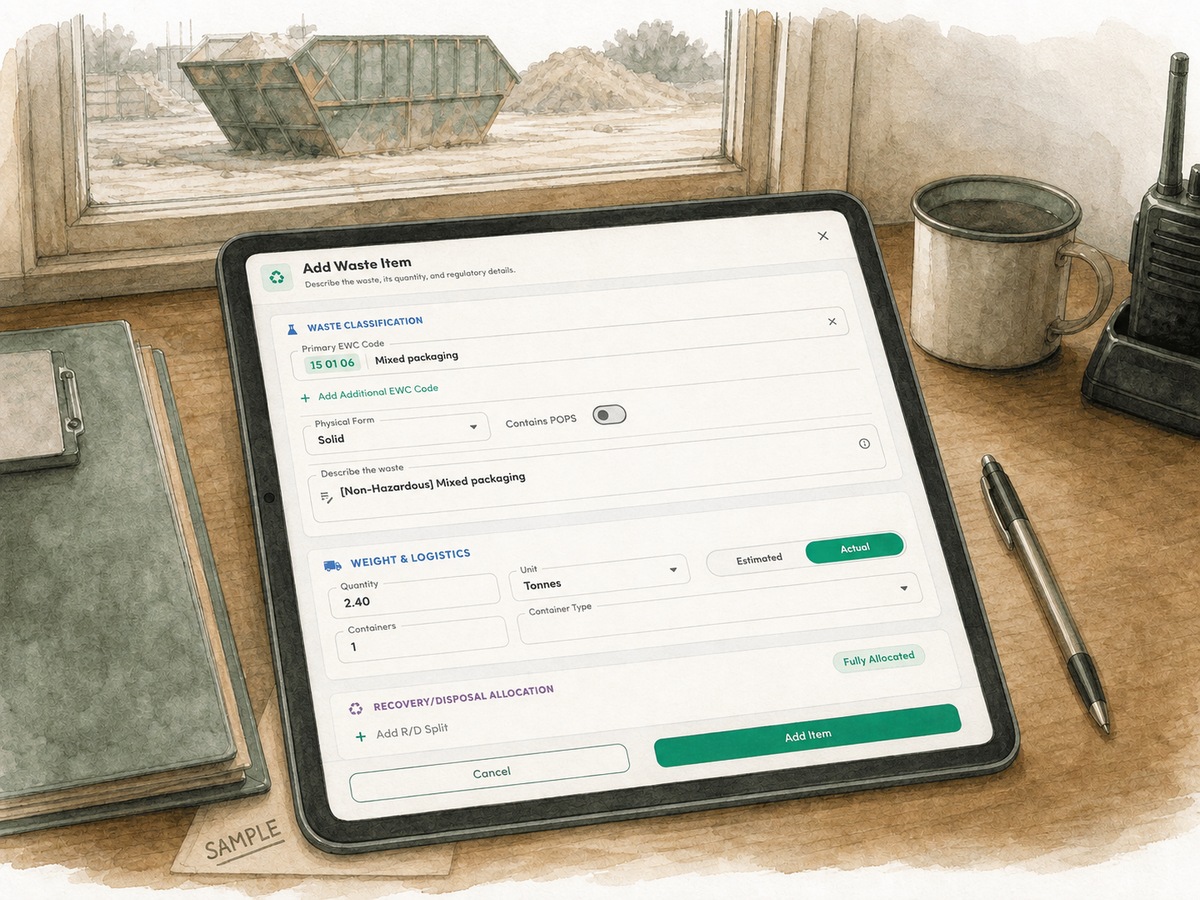
| Field | What it needs to say | Where it usually goes wrong |
|---|---|---|
| Description of the waste | Specific enough that the receiving site knows what's on the vehicle and can accept it under its permit. | "Mixed waste", "general", "rubbish". |
| Six-digit waste code | The List of Waste code that matches the description, with the asterisk where the entry is hazardous. | Wrong chapter, a code copied from the last job, a hazardous entry used for non-hazardous material. |
| How it's contained | Loose, in a skip, bagged, drummed, in an IBC, and how many. | Left blank. |
| Quantity | Weight or volume in a measurable unit. Actual if weighed, a stated estimate if not. | Blank, guessed wildly, or unreadable. |
| Transferor and transferee | Legal names and addresses of both parties, and which category each falls into (producer, carrier, broker, site). | Trading names that don't match the Environment Agency's records, old addresses. |
| Registration and permit details | Carrier registration number (CBDU or CBDL), and the receiving site's permit or licence number. | Lapsed registration, number missing or mis-typed. |
| Transferor's SIC code | The Standard Industrial Classification code of the business the waste came from. | Forgotten entirely. |
| Place, date and time | Where and when the transfer happened. | A date that doesn't match the booking or the weighbridge ticket. |
| Signatures | Both parties, with printed names. | One signature, or none, because nobody on site knew who was authorised. |
A season ticket (one note covering repeated transfers of the same waste between the same parties) can cover up to 12 months, provided nothing about the waste or the parties changes.
What changes under digital waste tracking
For a permitted or licensed receiving site in England and Wales, a digital receipt record is added in Defra's service. Existing waste transfer notes, hazardous consignment notes and returns continue until further notice throughout the chain.
For receiving sites
- Every incoming load is recorded digitally within two working days of the movement.
- The carrier is recorded by its existing carrier registration number. There is no new number.
- The paper note that arrived with the load and the weighbridge ticket are recorded alongside, so the digital record can be found by either.
- Hazardous components and concentration values are recorded; if a value is unavailable, the record explains why.
- Defra returns a tracking reference. Use it for corrections: act as soon as practicable and within one month of discovering an error, while errors blocking the original submission remain subject to the two-working-day deadline.
For carriers, brokers and producers
- Your own recording duty is planned for a later phase (October 2027 for carriers, brokers and dealers, not yet in statute).
- Keep producing and retaining transfer notes and consignment notes as now; receiving sites keep them too until further notice.
- From October 2026 the sites you use need accurate registration, waste-code and description details to make their receipt record. Poor or mismatched information can delay or prevent acceptance.
- Scotland and Northern Ireland receiving sites follow from 1 January 2027.
Nothing about the existing expectation has relaxed. Keep accurate records for the period that applies to your role and permit, and produce them when asked. The digital receipt record is an additional requirement; it does not remove the existing paperwork yet.
How the digital record catches the usual mistakes
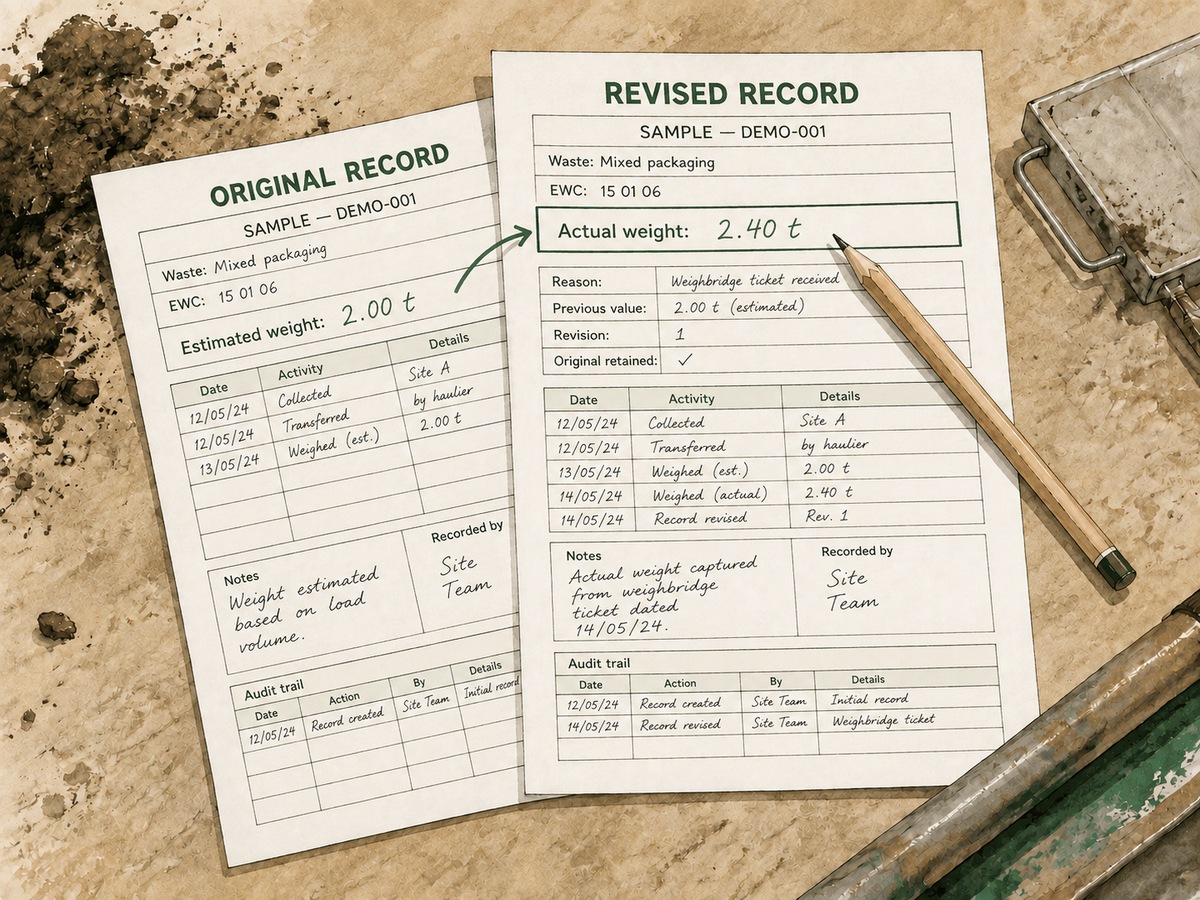
Structured fields make omissions easier to spot, but they do not remove the operator's duty to check the facts. The current demonstration shows a waste code selected with its description, carrier details looked up by registration number, weight marked actual or estimated, and a tracking reference returned. Test the route against your own checks, corrections and outage process before adopting it.
What the digital record can't do is tell you whether the codes and permits you loaded into it were right in the first place. That's the part we do.
Where IWS comes in
If you're not sure which notes you need, what to keep and for how long, or how your current paperwork maps onto the digital record, that's the sort of question we deal with every day. We review where you stand, clean up the codes and registrations, and set you up on our Defra-approved route.
IWS Permitting & Compliance
Your team: Nigel, Paul and Becky
Not sure your paperwork will stand up in October?
Send us your organisation, the site and a telephone number. We'll tell you plainly what's already right and what isn't.
Leave a recorded enquiry for the team.
We may hold your business contact details for compliance and marketing purposes. How we use your data.
Page last reviewed 5 September 2026.